 |
| MY FIRST PUBLICATION! WHITE BUTTERFLY Here it is, and yes, it's hard to believe after so many years of writing, researching, interviewing, re-writing, editing and so on, that White Butterfly, A journey out of the Philippines has finally made it to publication. This is a self-published effort, me as the Writer/Author and Luke the Narrator of his story. Almost six years ago I put myself to task and offered to help Luke write his story for what it was. He had already written his own diarised notes of the events that had touched both him and his family across in the Philippines. The accounts were so unbelievable that it screamed to be told so that readers could understand what goes on beyond our own shores, and how an everyday Australian can find himself so very deep within the unlikely corruption that eventually changes so many lives. When I took on this task to place the events in some kind of order so it would make sense for the reader, it soon became apparent it was not going to be easy. Luke and I spent countless hours going over every detail, only to uncover another and then yet another, and to say this guy has lived a colourful life, would be an understatement. During the time trying to gather all the information necessary to sort chapters and pull the story together, there were of course many roadblocks that would take much time then for researching and re-visiting with Luke to ensure I had everything right. Although this is a story told from Lukes's perspective, I have written it trying to capture every moment as he described it happening, a hard arduous duty I hope reflects within the pages, and as such, some of the accounts will be seen as repetitious and written like that of a diary, but this has been done on purpose. STORY OUTLINE When Luke returns from the Philippines to the Great Sandy Desert located in Western Australia following his marriage to Filipino wife Crystal, he finds himself caught-up in a bizarre series of life changing events that continue to haunt him. Sounds like an interesting read, secure your own copy in either Paperback or eBook Kindle, Tablet or Phone version through Amazon.com |
Sunday, 24 September 2023


Friday, 26 March 2021
ANOTHER WRITING ADVENTURE!
Who inspires you to write, to read, to chase your dreams, to learn new things, to motivate you?

For me, it's often...or always stories I hear, or have read by others that have taken that first step and found their courage to do something that in turn then inspires others to do the same. It's not always the same person, but multiple people who have gone on to do amazing things, accomplished or conquered life time goals by just taking action and saying to themselves I can do this and I will do this.
The first person who comes to my mind when I think of inspiration is Cheryl Strayed, Author of 'Wild.' Ever since having read her memoir, whenever I see something published or read one of her recent Facebook posts, it reminds me of where I want to be and what I want to achieve, and how much she has changed my outlook on life and how impact just one story can make to change your out look on life...the key is to never loose focus.
2021 has reminded me not waste any more time procrastinating on what I want to do and what I want to achieve, and where my goals always fall back to what I love to do and that is WRITING!
By luck, or by chance, I fell across a post on Instagram advertising courses, writing courses...of course! As such, I literally bit the bullet and decided to immediately enrol in this course - the Copywriting Essentials Course - through the Australian Writers Centre, and I'm loving learning this new skill that will take me in so many writing directions if I allow it to...and I will.
To be motivated, to make change you must move forward, and learning new skills I have learnt gives you that push to make the necessary changes, to believe in yourself that you can do it, everyone who's been there tells you the same, we just have to take that first or second or third or latest giant leap of faith for ourselves.
So, my personal endeavour is to become a freelance writer, make a living from my writing, something I love doing to earn an income, to be my own boss, choosing my own pathway and becoming successful at the same time.
Sounds like a plan! Wish me Luck!
Monday, 20 January 2020
Anne Frank
For me, this story will forever resonate as it was a childhood favorite, staying firm in the memory.
I couldn't leave the bookshop without buying my own copy of this children's rendition of her story. The cover is so cute!

About ghostwriting
 Sounds awesome, doesn't it...write someone else's story, get paid (and paid well at that), jobs done, and move onto to the next piece of work, but is that always really the case, even though it's the theory?
Monday, 2 December 2019
Feeling of the Day through Quotes
They allow us to resonate with our feelings the instant we read them. We uncannily think it was written for us, it must've been, why else would it suddenly appear at the very time and stage it has just when we're feeling it, living it.
It's also easy to get caught up in quotes we read. It will either make you feel better about yourself or a situation or it will catastrophise it.
I guess we can relate knowing that someone, somewhere has also felt the same intensity; after all they must've to have written it in the first place.
So here's a quote I stumbled across on Instagram, the writer is un-named but nevertheless, this sums up my feelings today.
Thursday, 28 November 2019
It's been a long time
Wow!! It has been a long time...
I can't believe it has been well over twelve months since I last blogged, it goes to show how easily things can slip and how quickly time passes by.
Life has been hectic though!!
One month after I last blogged I started a new position at work, it's been daunting to say the least. Then my youngest started High School, well that's a whole new story of it's own, we also had a new member of the furry kind join our household and now the race is on as to who reigns supreme between the teenager and the cat, I'd say at this stage it's even, although the teenager thinks the cat is more loved and is the favorite child...I'll leave that out for the jury to decide, but I think I'm in trouble.
Mostly though my time has been absorbed studying and today I can boldly say I have successfully completed my studies and I say that with the loudest sigh, could you hear it? I'm now a fully qualified Dispensary Technician within Pharmacy and I have to say I'm quite proud to share this as it has been a long road.
I feel like I've been held hostage over the last seven months of study, consuming an enormous amount of time with my head in the books and now it's back to my writing, and oh how I've missed my writing. I truly have missed just being able to sit and type away like I am now without that thought I should be doing something else.
I've felt so guilty too, as almost twelve months ago I promised a friend I would help write his story. I've found it's not an easy task writing someone else's story. The research part is enlightening, learning things I would otherwise be oblivious to. Some ordinary people do have extraordinary stories to tell. So now as promised I will continue on the path of compiling his story, however I'm feeling I could've bitten off more than I can chew in offering to do so. Without living something yourself, without knowing this person for an extensive period of time all plays into how difficult it is to put words on paper and sound authentic rather than sharing just a dairy log.
I'll keep everyone posted with my ideas and questions of which I would be highly grateful for suggestions from anyone who has ever endeavored to write someone else's story.
Until then, happy days!!
Tuesday, 31 July 2018
Over Sixty-Shades of Gray: A Journey Through Life's Later Years
 Over-Sixty: Shades of Gray: A Journey Through Life's Later Years by Barbara Paskoff
My rating: 4 of 5 stars
Here is a contemporary, uplifting look into the years of living sixty and beyond. Delivered with much-needed humor to lighten the load, the reader is successfully transported through the realities of getting older and how to best approach, and cope with, these changes when they arise.
This comprehensive overview will open your mind to matters you may not have already encountered or thought of and where health is placed at the forefront, providing a snapshot into some of life’s more serious challenges we might unluckily be faced with at some time or another. But don’t feel completely disheartened, for it’s not all doom and gloom as you might expect. Yes, health plays a major role in ageing, we all know that, but what about the positive up-side to getting older? And, yes, there seems there is an up-side. Retirement frees oneself up. So what about all that spare time on your hands; what will you do with that now? And how about the finances? Are they all in check? These are the type of questions that will get you thinking and where basic know-how is offered to provide some invaluable forethought. And then there’s the fun part of pre-planning one’s funeral that you might not have already thought about, where author Barbara Paskoff has it all worked out: “I’m making a guest list. If your name isn’t on it, it means I wouldn’t be caught dead with you.”
While each topic lends itself almost as a personal essay through the author’s own experiences, the messages conveyed remain effective, providing enough of an overview for the reader to make their own informed decisions and draw on their own conclusions, supported with both summaries and professional resources neatly tying up each chapter end.
I read through this book with the greatest of interest, particularly because I’m not yet sixty and, with saying that, I believe this book is not just precise for readers of that age group, nor is it gender specific; however, I did find that the book tends to lean a little more towards female interest than male. In fact, readers in their fifties (like myself) would find this book with true appreciation, providing a much-needed and important early insight, where time is the essence and pre-knowledge could hold the key before things sneak-up announced, which might, in fact, give a greater opportunity to overcome or avoid some obstacles otherwise left too late.
This a straight-forward, positive, go-to-guide that offers pre-planning and foresight on entering and living through our later years of life that will become a great resource for reference.
View all my reviews
Tuesday, 24 July 2018
Bryce Courtenay on Writing and other stuff

Thursday, 5 July 2018
NEW BOOK TITLE - Our Own Little Fictions
Ron's book received a 4 star rating review from San Francisco Book Review, which is available to read below, and available for purchase at the following link Amazon, happy reading.

 Author Bio:
Saturday, 30 June 2018
Being a good book reviewer

Considering I'm an Australian reviewer of books, I have to say I'm a little concerned, and now left questioning my own abilities as to whether I'm in fact a good or bad reviewer. So, with that said, I've done a little research on what makes a good reviewer, and luckily enough I think I'm following the basic rules in giving the books I read justice, along with providing potential readers enough guts for them to establish if these books are for them.
Here, I want to share some of the golden rules of reviewing I've learn't and continue to build on when I'm writing my reviews; after all practice makes perfect so they say.
My take on Golden Rules for Reviewing:
1. Make every review engaging, up-beat and a pleasure for others to read.
2. Include, where you can, a taste of the prose and narrative (this gives the reader an idea if they would want to buy the book). I actually truly believe in this rule. For one, I always read part of a chapter of a book I think I might be interested in when I pick-up a copy in a bookshop, just so I know if I like the style of writing; this is the same philosophy.
3. Understand and convey what you believe the author wishes to deliver to the reader through their writing. Here, you can provide a direct quotation.
4. Don't place too much emphasis on the plot summary and never, ever give away the ending.
5. Never make a review about the writer or the reviewer, a review is for the reader. It's about sharing ideas and information gathered through your reading, providing entertainment and education for the reader.
6. And always provide an honest review. What I mean by honest is if you didn't think the book works or conveys what is intended, then it is your job to tell the reader why, and show them evidence of your conclusion. Your job is not, however, to criticise the writer.
Reading is such a great pleasure to so many of us, so reviewers need to be committed, knowledgeable and just as scrupulous as their readers to remain successful at what they do.
Sunday, 17 June 2018
Author Interview with Nancy Chadwick for San Francisco Book Review
Interview With Nancy Chadwick, author of Under the Birch Tree
by Meredith Grant | Jun 13, 2018 | Author Interviews, Written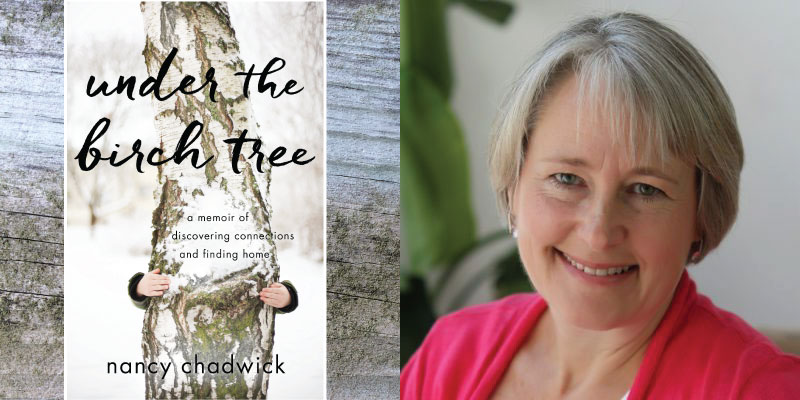
I had the pleasure of reading and reviewing Under the Birch Tree for San Francisco Book Review. Below is the written interview with Nancy on her upcoming publication this month, I hope you enjoy Nancy's insights and experiences she shares with us.
What first inspired you to write your story?
Connect with Nancy:
Wednesday, 9 May 2018
Picnic At Hanging Rock
 The return of an all time classic, Picnic At Hanging Rock, has now been
What is left for the reader to determine is if Joan Lindsay's 'Picnic At Hanging Rock,' is a work of fiction or fact? What do you think?
Saturday, 14 April 2018
How to be a book reviewer by Allena Tapia
- Hi bloggers, I am currently looking at book reviewing as my most current interest topic of writing, and came across this article by Allena Tapia which I found to give some very sound advice as far as starting out on the book reviewing platform. I wanted to share this as well as keep it close on hand for reference. If this is an area you're also interested in I hope it helps. Reviews can of course be new titles and older, I guess the focus would be on newer titles, but older titles / classics are in my opinion just as good to plug a book that resonates with you and could offer another reader some great reading. Start your platform with Goodreads and build your audience. Hope to hear from you guys on these platforms. Meredith
01 First, Act Like a Book Reviewer: Review Books, A LOT
/young-beautiful-woman-waiting-for-phone-call-176625373-5725757c3df78ced1f0cec77.jpg) Being a paid book reviewer likely sounds like a plum job for many writers, who generally love reading as much as writing. Despite this, it's certainly not a pipe dream. Seriously, I'm a real person, and I do it every day. There is indeed paid work available for book reviewers.
Being a paid book reviewer likely sounds like a plum job for many writers, who generally love reading as much as writing. Despite this, it's certainly not a pipe dream. Seriously, I'm a real person, and I do it every day. There is indeed paid work available for book reviewers.The first step is to obtain books on your own (at your own expense) and publish reviews on open platforms like Goodreads or Amazon. This helps the writer in several ways. First, it keeps you on top of the recent releases in your interest areas and genres. This is important because reviewing focuses on recent releases (with a few exceptions). It also teaches you the process of writing a book review. Interacting with other writers, reviewers and readers will help to shape your prose. You'll also get the chance to observe their review styles. Last, you may begin to develop a following of fans who appreciate your reviews and writing style. It is from this following that you build your audience for later endeavors.
02 Develop Your Own Book Review Outlet
/GettyImages-500816693-5759ff195f9b5892e88f4bc3.jpg) •••
•••Once you've got the hang of reviewing books, you'll want to develop a site or niche where you can publish your work yourself, such as a fan page or a blog. It helps to establish you as an expert, and puts the focus on you as a reviewer/brand, as opposed to Amazon reviews, which people may not associate as much with the review authors. It also serves to gather your prose/writing in one area/profile, which you can then use later on as evidence of your beautiful prose style and sparkling reviewer's wit. At this point, you are still generally shouldering the cost of the books yourself. However, there are platforms and site such as BookSneeze, which gives free books to some bloggers in exchange for published reviews. Personally, I recommend starting a book review blog, as you are in full control, and may even be able to monetize the site and begin earning pay for your reviews that much earlier. Also, you can then open your blog/site up to authors who are seeking reviews or doing blog tours. It might mean that you'll then start getting your books for free from the author/publishers. It also means that you'll be privy to brand new releases- ones that may not even be available to the public yet. Again, this will serve to underline you as an expert. Another bonus is that you begin to build relationships with those authors/publishers. Often, the books that you receive from these relationships and from places like BookSneeze are Advanced Readers Copies. It is a "rough draft" of the book produced for first readers and reviewers. These ARCs costs less to produce and can be sent out early, even if the final book isn't completely done. Also, ARCs can't be sold/resold on Amazon.com. It helps keep the new releases under wraps and keeps the profits with the publisher! If you can cultivate a relationship with a publisher at this point, you may have the good fortune of being put on their marketing/publicity list. It means that they'll send you emails or catalogs asking you which of their new releases you'd like a copy of. What a book lovers dream!
03 Gather Your Documents Together
/cheerful-high-school-student-using-laptop-for-making-homeworks-518954186-572576b13df78ced1f0eaa0c.jpg) It is now almost time to start chasing those paid opportunities. But, you need to prepare! Gather together your best reviews- the ones in which your prose just flows, and your passion is evident. Format them attractively and save them as a PDF. Also, if this particular review is on a site, save the URL, too, as some book reviewing jobs ask for links.
It is now almost time to start chasing those paid opportunities. But, you need to prepare! Gather together your best reviews- the ones in which your prose just flows, and your passion is evident. Format them attractively and save them as a PDF. Also, if this particular review is on a site, save the URL, too, as some book reviewing jobs ask for links.Next, prepare a resume focusing first on your book reviewing credits and skills, and second on your other writing credits and skills. Yes, it's true, some outlets who are in a position to pay book reviewers may request a traditional resume. However, they're not looking for a list of every job you've had in the past 5 to 10 years. They're looking for evidence of your writing/reviewing ability. Be sure to learn about how to write a job resume if you need help with this step.
Your last document will be a cover letter. It will generally be the text of an email responding to open jobs/projects. Put together a basic cover letter for a generic book review position, and then slant it for each potential project.
04 Pursue Paid Book Reviewing Jobs/Projects
/GettyImages-479977833-5759ff583df78c9b4643d93b.jpg) It's time to start making some dough. Even if you're hoping to focus on reviewing for specific magazines, or reviewing for a particular leader in the industry, I still recommend that you build up your credentials and give yourself some monetary encouragement by getting some paid work. Look for specific freelance writing jobs that ask for book reviewers. Yes, there are a few here and there. I run into this request at least once a month through my established freelance writing jobs lists. If you find an opportunity that you want to take up, respond specifically (tailor your cover letter) and quickly (as these guys get inundated fast). Don't be discouraged if you don't get a response. It is a volume game. When someone puts such an attractive job out there on the WWW, they likely have their pick of the litter. Keep trying.
It's time to start making some dough. Even if you're hoping to focus on reviewing for specific magazines, or reviewing for a particular leader in the industry, I still recommend that you build up your credentials and give yourself some monetary encouragement by getting some paid work. Look for specific freelance writing jobs that ask for book reviewers. Yes, there are a few here and there. I run into this request at least once a month through my established freelance writing jobs lists. If you find an opportunity that you want to take up, respond specifically (tailor your cover letter) and quickly (as these guys get inundated fast). Don't be discouraged if you don't get a response. It is a volume game. When someone puts such an attractive job out there on the WWW, they likely have their pick of the litter. Keep trying.You may pick up some regular clients in this manner, which is always good, since, hey, you've reached your goal! You are now a paid book reviewer! (But read on anyway.) Generally, these companies, sites, or publications have a relationship with the publisher, so you'll likely receive the review copy from your new client. It may vary, though.
One side note here. There are often authors or companies that pay reviewers for positive reviews. It is an ethical consideration for you if you want to continue and be accepted in the book reviewing field. Generally, a reviewer is thought to be an impartial source.
Check out this New York Times article on paid book reviewers for more information.
05 Pitch to Magazines, Journals and Newspapers
/GettyImages-457207765-5759ff9c5f9b5892e89014fa.jpg) Now that you're an established book reviewer with a few (paid) clips in your portfolio, the next level could be getting your reviews placed in publications- both print and online. It might net you a wider audience, and certain publications net you some cred as a writer/reviewer. Also, print publications may pay a bit better, too.When I say "publications," I am including the big guys here: Booklist from the ALA, Kirkus Reviews and Publisher's Weekly. Of course, you may want to start smaller, such as with a regional rag, and build up to the power players, right?
Now that you're an established book reviewer with a few (paid) clips in your portfolio, the next level could be getting your reviews placed in publications- both print and online. It might net you a wider audience, and certain publications net you some cred as a writer/reviewer. Also, print publications may pay a bit better, too.When I say "publications," I am including the big guys here: Booklist from the ALA, Kirkus Reviews and Publisher's Weekly. Of course, you may want to start smaller, such as with a regional rag, and build up to the power players, right?I've covered how to query magazines extensively on this site, and the process is similar to book reviews. However, there might be a bit of variety. For example, some editors may want to see the review in total, as opposed to pitch or query letters. Some may list you as an ongoing potential reviewer, one in a pool, and send you books that match your stated interests or expertise areas every so often. Some may come to you with potential titles, whereas some may let you pitch titles that you think their readership would like.
Finding outlets that accept book reviews is similar to finding magazines to publish your other written work: start with the Writers Market or visit the magazine's website.
06 Keep Current and Get Educated
/GettyImages-555798991-5759ffd43df78c9b46449723.jpg) Retain your status as a paid, professional book reviewer by staying current and relevant in the field. Keep on top of new releases, specifically those in your favorite genres. In addition, most major book sites like Amazon and Barnes and Noble have sections regarding upcoming releases. Following publishers on Twitter, or signing up for their marketing emails may also result in insider scoops.
Retain your status as a paid, professional book reviewer by staying current and relevant in the field. Keep on top of new releases, specifically those in your favorite genres. In addition, most major book sites like Amazon and Barnes and Noble have sections regarding upcoming releases. Following publishers on Twitter, or signing up for their marketing emails may also result in insider scoops.In addition, consider joining the National Book Critics Circle, a professional association for book reviewers. They offer education and networking resources for reviewers, along with updated listings of potential outlets. Wondering why this recommendation is at the end of your process? It's because the NBCC is open to professional reviewers who can show published review clips. Now, t
BY ALLENA TAPIA
Updated November 12, 2017
Saturday, 23 July 2016
New book review - 'Wild' by Cheryl Strayed

Hi everyone, just letting you know I have posted my review of Cheryl Strayed's 'Wild.' To find it just head over to Reviews. Hope you enjoy it.
Thursday, 7 July 2016
The Little Library - Melbourne

Yes, it's a community library where any one can visit, sit, read, relax, meet other people, talk, learn and borrow or swap books all on an honesty system.
Although it's not purely just for those who may be homeless, it certainly breaks down barriers allowing anyone from any walk of life to go in without feeling as though they don't belong, or can't afford its luxury.
Located within Melbourne Central, on Level 2, you could be excused for almost passing without noticing; myself included.
Inside you'll see what looks like a bookstore, but it is so much more. The Little Library is a place where absolutely anyone can come and borrow or swap a book for free. There is no membership, there is no shopkeeper or security guard, it is all done on honesty.
I would hope every major city could invest in utilising a space to provide this same concept for their own locals. Wow, what food for thought!
Sunday, 29 May 2016
SHORT FICTION - LOCAL COLOR
I hope that wasn't a sigh I heard?
Anyway, this new opportunity meant research, another new concept for me for most of my writing is strongly non-fictional, but I was ready for something different, ready for a new challenge and who knows I might pull something great off.
For those who don't know what 'Regionalism and local color' writing is, here's a little bit about it.
By definition, local color is defined as the characteristics and traits that make a location unique, like the gold fields - as I happened to choose for my story. It's about the food shops and attitudes of the people in a town.
Local color stories concentrate on landscape, dialect like that found in Mark Twain's The Adventures of Huckleberry Finn, it's about customs and folklore specific to geographic region or locale. It's said that the setting can be so integral to the story that it sometimes becomes a character itself.
Thematically, many local color stories share an aversion to change, a weakness for sentimentality or nostalgia for the anachronistic beliefs of a past. It's a place where characters adhere to traditional gender, ethnic and social economic roles - so it's like keeping things real. But when it comes to plot, often very little happens for the storytelling itself revolves mostly around the community and it's rituals rather than one character's experiences.
Local color taught me a thing or two other than writing in a new genre, it taught me the importance of accuracy in research and how I was able to manipulate what I found to structure my own story and characters in a way I visualised. It allowed me to have fun with characters, setting and dialect, so much so perhaps my story wandered more towards character than locale - I don't know - I'll leave that for the judges to decide.
Regardless, this new sense of short-fiction writing brought new life and interest for me personally, I really felt my character's come alive more than ever, I could really see them living how I plotted their lives and most importantly it gave me a far more thorough understanding of my own locale I never knew existed. It presented an opportunity to visit local cemeteries and historic land marks, such as old mines I never would've otherwise. It gave me the in-depth knowledge needed to understand local history and then translate that into something inspiring through my penmanship.
I've added a few paragraphs of my local writing in my page titled 'Writing Stuff,' please head over and have a read, tell me what you think.
Wednesday, 13 January 2016
Bookshop of Kabul- Bookshops Of the World

The Bookseller of Kabul was one of many books listed on my bucket list of books to read and quickly became one of my many favorite reads.
This post was inspired by The Bookseller of Kabul, with real photo's of the bookshop itself. Pictured opposite is the real man behind the story Shah Muhammad Rais.
Yes it's an International bestseller, but what I've come to learn since having read this extraordinary book first published in 2002 is how much controversy the Author Asne Seierstad caused due to telling the story of Sultan Khan (Shah Muhammad Rais).
It surprises me that Shah Muhammad Rais found this account of his life so incorrectly depicted, especially when the Author shared four months of her life in Shah's home to write of his and his families experiences as Afghani's. How welcoming they had been, how open, honest they were with Asne, and how careful Asne consciously made the effort in telling their story through their own words and feelings.
Asne writes the foreward appearing to be so aware in maintaining anonymity, telling a story as she puts it, in literary form, while based on real events.

It's easy to read this story wondering if it's actually fiction or fact; sign of a good writer many would agree!
There's always two sides to every story though isn't there?
It's reported that Shah Muhammad Rais and his family sought asylum in Norway as political refugee's after things revealed about them from the publishing of the book made life in Afghanistan unsafe. Shah then went on to publishing his own book, Once upon a time was a bookseller in Kabul, which tells his own story.

Extract:
September 10 2003
LET THERE BE LIGHT
By: Shah M Rais
It was my heartfelt desire to come to Norway and say hello to newfound Norwegian friends who had read a book, which was supposed to accurately depict my lifelong struggle against fundamentalism, tyranny and illiteracy in Afghanistan from the window of Asne's home. I never dreamed that the opposite circumstances would have arisen, circumstances that I never could have imagined when I extended to her my hospitality, precious time, and the benefits of my experience during a moment of tragedy and crisis for my country and the world. Instead of writing a true portrait of my family, my country, and myself she has closed the window on truth, defaming all of us in her cold desire for money, believing that the low and the salacious would sell better than the high and the honest. In this she has proved temporarily correct, but there is too much light flowing through the many windows opened by honest people during the global ordeal that terrorism has caused for such a hollow victory to last.
She has told the press that she has written or said nothing to put me in danger.
Monday, 4 January 2016
Bookshops of the World
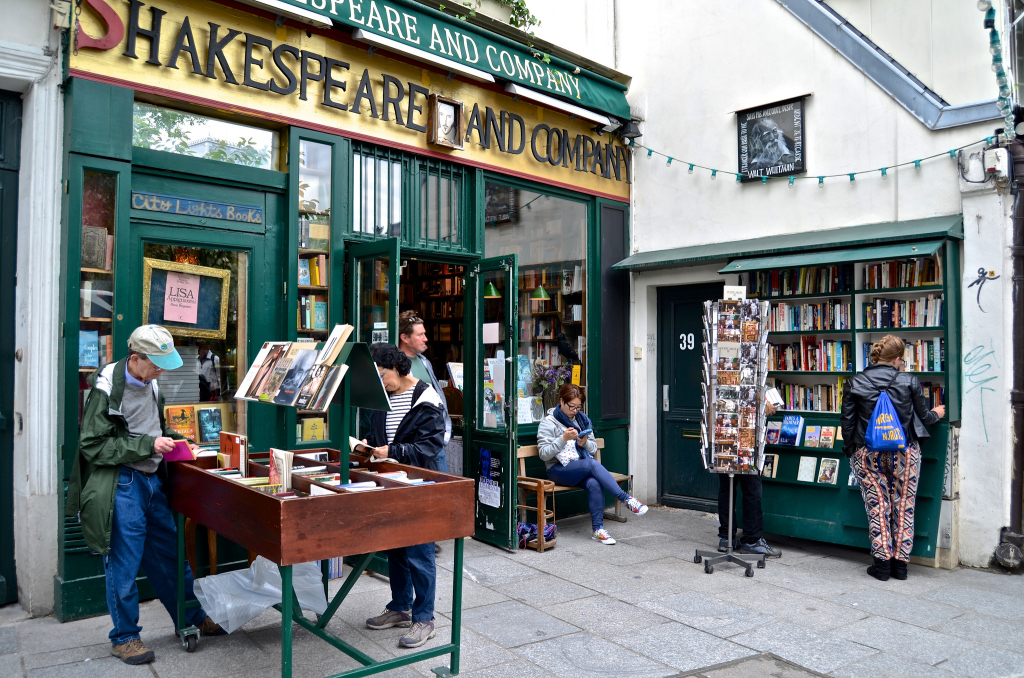
"I created this bookstore like a man would write a novel, building each room like a chapter, and I like people to open the door the way they open a book, a book that leads into a magic world in their imaginations." —George Whitman


The bookshop was founded by American George Whitman at 37 rue de la Bûcherie, Kilometer Zero, the point at which all French roads begin. Constructed in the early 17th century, the building was originally a monastery.

When the store first opened, it was called Le Mistral. George changed it to the present name in April 1964—on the four-hundredth anniversary of William Shakespeare’s birth—in honor of a bookseller he admired, Sylvia Beach, who’d founded the original Shakespeare and Company in 1919. Her store at 12 rue de l’Odéon was a gathering place for the great expat writers of the time—Joyce, Hemingway, Stein, Fitzgerald, Eliot, Pound—as well as for leading French writers.
From the first day the store opened, writers, artists, and intellectuals were invited to sleep among the shop’s shelves and piles of books, on small beds that doubled as benches during the day. Since then, an estimated 30,000 young and young-at-heart writers and artists have stayed in the bookshop, including then unknowns such as Alan Sillitoe, Robert Stone, Kate Grenville, Sebastian Barry, Ethan Hawke, Jeet Thayil, Darren Aronfsky, Stephen Rea, David Rakoff, and Linda Grant. These guests are called Tumbleweeds after the rolling thistles that “drift in and out with the winds of chance,” as George described. A sense of community and commune was very important to him—he referred to his shop as a “socialist utopia masquerading as a bookstore.”

Three things are asked of each Tumbleweed: read a book a day, help at the shop for a few hours a day, and produce a one-page autobiography. Thousands and thousands of these autobiographies have been collected and now form an impressive archive, capturing generations of writers, travelers, and dreamers who have left behind pieces of their stories.
In 2002, at the age of twenty-one, Sylvia Whitman, George’s only child, returned to Shakespeare and Company to spend time with her father, then eighty-eight years old, in his kingdom of books. In 2006, George officially put Sylvia in charge. On the shutters outside the store, he wrote: “Each monastery had a frère lampier whose duty was to light the lamps at nightfall. I have been doing this for fifty years. Now it is my daughter’s turn.”
Sylvia introduced several new literary endeavors. In June 2003, Shakespeare and Company hosted its first literary festival, followed by three others. Participants over the years have included Paul Auster, Will Self, Marjane Satrapi, Jung Chang, Philip Pullman, Hanif Kureishi, Siri Hustvedt, Martin Amis, and Alistair Horne, among many others.
In 2011, with the de Groot Foundation, Shakespeare and Company launched the Paris Literary Prize, a novella contest open to unpublished writers from around the world. In recent years, the bookstore’s had cameo appearances in Richard Linklater’s Before Sunset and Woody Allen’s Midnight in Paris. Shakespeare and Company also continues to host at least one free literary event a week, and has been delighted to welcome young and emerging writers along with today’s leading authors.
The shop’s latest projects include a Shakespeare and Company publishing arm and an ongoing search for a farm and writers’ retreat in the countryside around Paris.
Although George Whitman passed away on December 14, 2011—two days after his 98th birthday—his novel, this bookshop, is still being written, both by Sylvia and by the thousands of people who continue to read, write, and sleep at Shakespeare and Company.
If I ever visit Paris, this will be a must visit on my bucket-list of places to see before I die.
Notes shared in this post have been resourced from Shakespeare and Co's website titled "History."
Saturday, 2 January 2016
January's Author Spotlight

Each month I hope to introduce you to a special author whom I've come to love and perhaps even resonate with his or her writing on a very personal level; it might even include an author I have either just experienced or endeavor too via spotting a read of new interest. Some of you may already know some of these authors from having already read their books. Some authors we may get to know together for the first time, sparking a common interest in wanting to read something completely different to the usual genres we're use to.
Either way I hope you enjoy this new addition to my blog for 2016.
Just for the record, Paulo Coelho has become one my most read and favorite authors. His writing brings deep emotional attachment and thinking, it makes you want to live a better, fuller life; a purposeful life. After reading one of his books, I'm left pondering my own life's purpose, life's value and I feel much alive with this experience I never want to let go.
Brazilian author Paulo Coelho is considered one of the most influential authors of our times, he's also become one of my all time favorite authors having read a huge line-up of his books including 'The Pilgrimage' and 'The Alchemist.' His books have sold more than 165 million copies worldwide, have been released in 170 countries and been translated into 80 languages; what author could ask for anything more.
Born in Rio de Janeiro in 1947 he soon discovered his vocation for writing. His career includes working as a director, theater actor, songwriter and journalist. His collaboration with Brazilian composer and singer Raúl Seixas gave some of the greatest classic rock songs in Brazil.
In 1986, a special meeting led him to make the pilgrimage to Saint James Compostela (in Spain). The Road to Santiago was not only a common pilgrimage but a turning point in his existence. A year later, he wrote 'The Pilgrimage', an autobiographical novel that is considered the beginning of his career.
In the following year, Coelho published 'The Alchemist'. Slow initial sales convinced his first publisher to drop the novel, but it went on to become one of the best selling Brazilian books of all time much to Coelho's surprise. The story of Santiago is a testament to how powerful our dreams can be and the importance of listening to our hearts. It really is a must read for any avid reader, believer or anyone looking to transform or add true meaningfulness to their lives.
Other titles include 'Brida' (1990), 'The Valkyries' (1992), 'By the River Piedra I Sat Down and Wept' (1994), the collection of his best columns published in the Brazilian newspaper Folha de S. Paulo entitle 'Maktub' (1994), the compilation of texts 'Phrases' (1995), 'The Fifth Mountain' (1996), 'Manual of a Warrior of Light' (1997), 'Veronika decides to die' (1998), 'The Devil and Miss Prym' (2000), the compilation of traditional tales in 'Stories for parents, children and grandchildren' (2001), 'Eleven Minutes' (2003), 'The Zahir' (2005), 'Like the Flowing River' (2006), 'The Witch of Portobello' (2006), 'The Winner Stands Alone' (2008), 'Aleph' (2010), 'Manuscript found in Accra' (2012) and 'Adultery' (2014).
You'll love them all!
Coelho has received numerous prestigious international awards, amongst them being inducted into the Brazilian Academy of Letters in 2002 and Messenger of Peace by the United Nations since 2007. In 2009 he received the Guinness World Record for the most translated author for the same book (The Alchemist).
This title is one I have not yet read, however will make it one of my priorities for 2016; here's a little look at what it's all about. If you've already read it please leave your comments and thoughts.

The new novel from internationally acclaimed author Paulo Coelho - a dramatic story of love, life and death that shows us all why every second of our existence is a choice we all make between living and dying. Veronika has everything she could wish for. She is young and pretty, has plenty of boyfriends, a steady job, a loving family. Yet she is not happy; something is lacking in her life, and one morning she decides to die. She takes an overdose of sleeping pills, only to wake up some time later in the local hospital. There she is told that her heart is damaged and she has only a few days to live. The story follows Veronika through these intense days as to her surprise she finds herself experiencing feelings she has never really felt before. Against all odds she finds herself falling in love and even wanting to live again...
Monday, 28 December 2015
Bookshops of the World

I don't know what it is but unusual shops like this gets my heart rate going in a good way, especially when it houses books.
My favorite all-time bookstores are those old stores - not the musty, smelly types, but the old-style that surround you in all their glory of colorful jackets lining the walls from floor to ceiling, boasting new titles you've not seen before or perhaps have forgotten about until now.
One of my all time favorite stores like this is The Hill of Content Bookstore located in Bourke st Melbourne. It wasn't until I'd visited the Reading's bookstore at the State Library Melbourne that I learnt of this quaint bookshop after a staff member kindly referred me there.

Yep, this bookstore is as good as they can get. I don't know about you but I can't get enough of being surrounded in books and this is what you get when you visit the Hill of Content bookshop. In my opinion nothing can beat an old style book store either, with a rickety sweeping stair-case taking you to a new level of more books; more books! You can also find the often very hard to get journals like The Australian Book Review. I usually visit this bookstore with a list in hand of titles I'm keen to take home and more than often I leave with titles I never came out looking for - but never disappointed in doing so. Who would go to Big W to buy a copy when they could spend a few lazy hours perusing the shelves here?
If you haven't yet been fortunate enough to visit this bookstore I highly recommend that next time your in Melbourne include a visit here.
-
Yes, I am dissappointed to say that my manuscript has returned following an enduring 5 months of waiting to hear a verdict. I have to add ...
-
 For every good writer there must be a good reader; so they say. I actually do agree with this. Reading broadens your imagination, it allow...
 -
 S ounds awesome, doesn't it...write someone else's story, get paid (and paid well at that), jobs done, and move onto to the next pi...