Thursday, 28 November 2019
It's been a long time
Wow!! It has been a long time...
I can't believe it has been well over twelve months since I last blogged, it goes to show how easily things can slip and how quickly time passes by.
Life has been hectic though!!
One month after I last blogged I started a new position at work, it's been daunting to say the least. Then my youngest started High School, well that's a whole new story of it's own, we also had a new member of the furry kind join our household and now the race is on as to who reigns supreme between the teenager and the cat, I'd say at this stage it's even, although the teenager thinks the cat is more loved and is the favorite child...I'll leave that out for the jury to decide, but I think I'm in trouble.
Mostly though my time has been absorbed studying and today I can boldly say I have successfully completed my studies and I say that with the loudest sigh, could you hear it? I'm now a fully qualified Dispensary Technician within Pharmacy and I have to say I'm quite proud to share this as it has been a long road.
I feel like I've been held hostage over the last seven months of study, consuming an enormous amount of time with my head in the books and now it's back to my writing, and oh how I've missed my writing. I truly have missed just being able to sit and type away like I am now without that thought I should be doing something else.
I've felt so guilty too, as almost twelve months ago I promised a friend I would help write his story. I've found it's not an easy task writing someone else's story. The research part is enlightening, learning things I would otherwise be oblivious to. Some ordinary people do have extraordinary stories to tell. So now as promised I will continue on the path of compiling his story, however I'm feeling I could've bitten off more than I can chew in offering to do so. Without living something yourself, without knowing this person for an extensive period of time all plays into how difficult it is to put words on paper and sound authentic rather than sharing just a dairy log.
I'll keep everyone posted with my ideas and questions of which I would be highly grateful for suggestions from anyone who has ever endeavored to write someone else's story.
Until then, happy days!!


Tuesday, 31 July 2018
Over Sixty-Shades of Gray: A Journey Through Life's Later Years
Here is one of the latest titles I've recently had the pleasure to review, I enjoyed this read and highly recommend it to anyone 50+
 Over-Sixty: Shades of Gray: A Journey Through Life's Later Years by Barbara Paskoff
My rating: 4 of 5 stars
Here is a contemporary, uplifting look into the years of living sixty and beyond. Delivered with much-needed humor to lighten the load, the reader is successfully transported through the realities of getting older and how to best approach, and cope with, these changes when they arise.
This comprehensive overview will open your mind to matters you may not have already encountered or thought of and where health is placed at the forefront, providing a snapshot into some of life’s more serious challenges we might unluckily be faced with at some time or another. But don’t feel completely disheartened, for it’s not all doom and gloom as you might expect. Yes, health plays a major role in ageing, we all know that, but what about the positive up-side to getting older? And, yes, there seems there is an up-side. Retirement frees oneself up. So what about all that spare time on your hands; what will you do with that now? And how about the finances? Are they all in check? These are the type of questions that will get you thinking and where basic know-how is offered to provide some invaluable forethought. And then there’s the fun part of pre-planning one’s funeral that you might not have already thought about, where author Barbara Paskoff has it all worked out: “I’m making a guest list. If your name isn’t on it, it means I wouldn’t be caught dead with you.”
While each topic lends itself almost as a personal essay through the author’s own experiences, the messages conveyed remain effective, providing enough of an overview for the reader to make their own informed decisions and draw on their own conclusions, supported with both summaries and professional resources neatly tying up each chapter end.
I read through this book with the greatest of interest, particularly because I’m not yet sixty and, with saying that, I believe this book is not just precise for readers of that age group, nor is it gender specific; however, I did find that the book tends to lean a little more towards female interest than male. In fact, readers in their fifties (like myself) would find this book with true appreciation, providing a much-needed and important early insight, where time is the essence and pre-knowledge could hold the key before things sneak-up announced, which might, in fact, give a greater opportunity to overcome or avoid some obstacles otherwise left too late.
This a straight-forward, positive, go-to-guide that offers pre-planning and foresight on entering and living through our later years of life that will become a great resource for reference.
View all my reviews
Tuesday, 24 July 2018
Bryce Courtenay on Writing and other stuff
Recently I picked up a copy of Bryce Courtenay's
The Silver Moon - Reflections on Life, Death and Writing.

I have to be honest, out of eight titles I own of Bryce Courtenay's, I have only managed to read two of them from start to finish. April Fools Day, published in 1993 was one of those titles, the other was The Power Of One, published in 1989.
The Silver Moon is a portrait of Bryce's work where he as the title suggests reflects upon his life before, during and after becoming a popular fiction writer. You get to see Bryce not only as a writer / storyteller but as a husband, father and friend.
I loved reading through and absorbing the abundance of advice he provides for anyone who wants to be a good writer, to improve their writing and grasp the basic necessity's in understanding what is most important in being successful in storytelling.
I wish I had been fortunate enough to attend one of Bryce Courtenay's masterclasses. I think the personal gratification in meeting him and learning from his valuable lessons would've been second to none. His courses stretched out over five days within several countries including Australia - with the National Library of Canberra home to these classes. I think it would've been nice to look back, especially now Bryce Courtenay has passed away and say, I was fortunate enough to meet and learn from this guy.
Here's a quote that stood out for me. It's not just a play on words, a thought or process, but it resonates and has meaning, it's the truth and everyone can place themselves somewhere within this tier of life.
"You live three lives.
One growing up; one being responsible, paying the mortgage and having kids, and one being yourself. I'm in my third stage." he tells.
One of Bryce's teachings of writing, not just popular fiction, but any writing, is considering your reader as paramount ( treat them as a fourth protagonist) after all your telling them the story and their listening attentively, so keep their attention alive.
"Writing is about practice and practice takes time."
"Writing requires thinking at a deeper level than most things, and most writers find that they grow intellectually in the process of writing."
If you're a writer, like myself, then perhaps like me you understand the last passage. I often have people say to me I'm a deep thinker, but I've never associated that thought with me as a writer; now I do. And yes, as writers we must become more intellectual because we learn so much through writing.
The Silver Moon, should be every writers ambition to read at least once; for me, I believe it should be an essential addition among my books on writing, taking pride of place among the rest of them. I'm so glad I picked this book up at the library and got to read it, learn from it and gain a respect for Bryce Courtenay I wouldn't have otherwise known.
Finally,
"I'm a storyteller.
Some people are plumbers, some people are doctors, some are lawyers.
I'm a storyteller."
Thursday, 5 July 2018
NEW BOOK TITLE - Our Own Little Fictions
Hi bloggers, well as you all should know by now I have an unrelenting addiction for memoir, so I have ceased the opportunity to showcase Ron Rhody's latest piece of work titled Our Own Little Fictions (ironically).
Ron's book received a 4 star rating review from San Francisco Book Review, which is available to read below, and available for purchase at the following link Amazon, happy reading.
Our Own Little Fictions by Ron Rhody

San Francisco Book Review – 4 Stars
Book Summary
This is a story about a slice of time, and a place, and cluster of people worth remembering. It begins in a small river town in the Bluegrass of Kentucky and concerns itself with beginnings and becomings, with home places and who you can count on, and where untaken roads lead. A few early readers comments “A beautifully written remembrance of a young man lifted and loved through the sheer ordinariness of family and coming of age. Well worth the read.” - Cynthia Kasabian, CKB Consultants, San Francisco. "An unconventional book but strangely engaging. Not a 'must read.' But definitely a 'glad I did read.'" - Annette Bowen, Inside/Outside, Atlanta. “Fascinating! This book is like a conversation on paper.” - Charlie Baglan, Kentucky Afield radio, Frankfort, Ky. “Deeply personal, often moving.” - Bob Irelan, author, Rancho Murrieta. Ca. "Thought provoking. It causes readers, especially in today's all-consuming digital world, to reflect on how memories have shaped their lives." - Joseph Piedmont, Gallatin Public Affairs (Ret.) Portland, Or. Each life is a story. Each story is unique. If we don’t tell each other our stories, how will we know what life is all about? Pretend you’re listening.
According to Ron Rhody’s wife, he is not eligible for authoring a memoir. He hasn’t won an Oscar or an MVP or a Nobel prize. And yet Rhody has a story he wants, needs, to tell. His story. And so that’s how he will tell it to us: as one of Our Own Little Fictions.
Reminiscent of Sarah Polley’s documentary Stories We Tell, Rhody meanders through his memory and down the real roads he’s traveled all over the U.S., from his beloved Frankfort, Kentucky, to California and back (via Florida and Alabama) and then back out to California. Along this circuitous route through his youth, manhood, and ancestry, we encounter all sorts of colorful characters, historical events, family triumphs, and tragedies, which in large part amount to the man whose story we’re being told.
The place closest to Rhody’s heart is clearly Frankfort, Kentucky. It is there his father, a newspaperman, fought for civil rights and to put down roots for his forward-thinking family. Though a wanderlust would uproot the Rhodys and send them all over the U.S., Kentucky kept calling them back to the heart of the heart of their country. In Our Little Fictions, Frankfort is origin and refuge, and it serves as the Ithaca of the author’s Odyssey.
These chronicles of Rhody contain all the joy and pain of an American life that spans the Cold War to the present. We meet his parents, grandparents, wife and children, friends and mentors. From animated anecdotes of a hard-nosed football coach doling out life lessons to the memorial for a dear friend and author of “sixteen erudite books,” we witness a life pass in time-lapse frames of laconic, Hemingwayesque prose.
Hemingway and his suicide haunt the narrative beginning to end. On a road trip from California to Kentucky, Rhody and his son make a scheduled detour to Hemingway’s home in Idaho (where he’d put the shotgun in his mouth).
“It seemed wrong that Hemingway had killed himself.
Nature should have gotten him.
Or chance.”
Later in the
narrative and earlier in time, news of Hemingway’s suicide reaches Rhody, and
he reflects on the premature tragedy, as well as his own (missed?) calling.
These two time periods intermingle, and Rhody leaves Idaho with “an answer to a
question I hadn’t known I’d asked.” Authorship was an alternative path he’d
bypassed only to embark upon late in life.
Late in life,
indeed. The long road approaches its end and the loss of loved ones is an
inevitability. Each story has the same conclusion, alas, and many of the
characters we encounter in this Appalachian saga pass on in heartrending
deathbed scenes and austere funerals. The depiction of these tragedies is
sentimental, even cliched, but anything less/more would not be true to life. It
is the commonality of these cliches that arise in endless variations, like
updates of Shakespeare.
No, Ron Rhody
is no Prince Hamlet, nor was he meant to be, but his story of “becoming,” with
its conduplicatio, terse punch-lines, and homespun wisdom, is one that will
always be in need of telling and retelling.
Reviewed By:
Steven Felicelli
 Author Bio:
Ron Rhody has been a reporter, a sportswriter, and a broadcast journalist before morphing into a career as a corporate public relations executive. He's done four novels. This is his first stab at a "sort-of-memoir." Find more info at http://www.outerbankspublishing.com
Saturday, 30 June 2018
Being a good book reviewer

Considering I'm an Australian reviewer of books, I have to say I'm a little concerned, and now left questioning my own abilities as to whether I'm in fact a good or bad reviewer. So, with that said, I've done a little research on what makes a good reviewer, and luckily enough I think I'm following the basic rules in giving the books I read justice, along with providing potential readers enough guts for them to establish if these books are for them.
Here, I want to share some of the golden rules of reviewing I've learn't and continue to build on when I'm writing my reviews; after all practice makes perfect so they say.
My take on Golden Rules for Reviewing:
1. Make every review engaging, up-beat and a pleasure for others to read.
2. Include, where you can, a taste of the prose and narrative (this gives the reader an idea if they would want to buy the book). I actually truly believe in this rule. For one, I always read part of a chapter of a book I think I might be interested in when I pick-up a copy in a bookshop, just so I know if I like the style of writing; this is the same philosophy.
3. Understand and convey what you believe the author wishes to deliver to the reader through their writing. Here, you can provide a direct quotation.
4. Don't place too much emphasis on the plot summary and never, ever give away the ending.
5. Never make a review about the writer or the reviewer, a review is for the reader. It's about sharing ideas and information gathered through your reading, providing entertainment and education for the reader.
6. And always provide an honest review. What I mean by honest is if you didn't think the book works or conveys what is intended, then it is your job to tell the reader why, and show them evidence of your conclusion. Your job is not, however, to criticise the writer.
Reading is such a great pleasure to so many of us, so reviewers need to be committed, knowledgeable and just as scrupulous as their readers to remain successful at what they do.
Sunday, 17 June 2018
Author Interview with Nancy Chadwick for San Francisco Book Review
Interview With Nancy Chadwick, author of Under the Birch Tree
by Meredith Grant | Jun 13, 2018 | Author Interviews, Written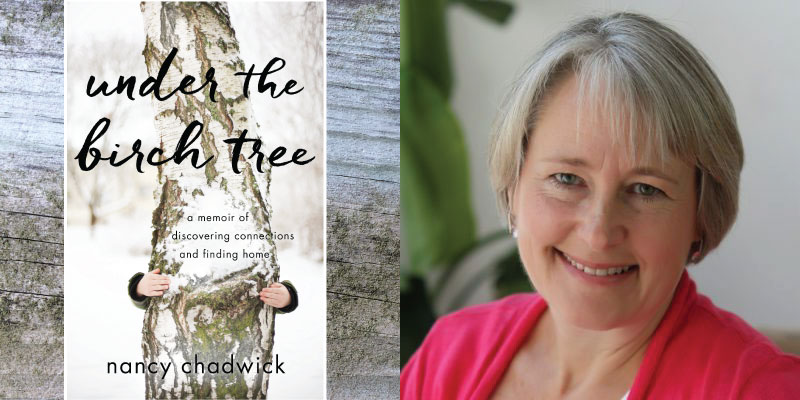
I had the pleasure of reading and reviewing Under the Birch Tree for San Francisco Book Review. Below is the written interview with Nancy on her upcoming publication this month, I hope you enjoy Nancy's insights and experiences she shares with us.
What first inspired you to write your story?
There was something about trees. When I was a young girl, maybe eight or ten, I was a walker who enjoyed the outdoors, just roaming around and exploring. I liked to walk around the perimeter of my house, starting and ending at the front where my favorite tree, a birch, grew. I loved that tree, especially because of how it looked with its peeling white bark and wavy slender leaves. It always reminded me of home; they were one and the same. I felt strongly about establishing one’s roots and a sense of belonging and home that my early steps around the foundation of my home became an idea worth developing.
Under the Birch Tree is all about discovering connections and finding home; tell us how and why the family homes birch tree became a main source of connection and companionship for you?
I connected to this tree for a couple of reasons. First, I connected to it because of its very nature. The birch tree is associated with spring and new beginnings and appears light and clear and flexible and can also be reactive to external situations – water, light, temperature. That is why my birch buddy is woven throughout my story. It became a metaphor for my self-discovery for finding home. When I would spot a tree, instant memories put me back to a place I associated with comfort, security and the familiar.
How did you find the writing process for Under the Birch Tree? Did it come easily? Did you find it evoked any unwanted emotions?
I wrote the first draft over ten years ago and it consisted of memories of experiences. Writing the events was the easy part. The more difficult part was figuring out why I remembered what I did and what sense it made. The process was emotional and, wanted or not, it was important that all my emotions played out. My emotions were my voice.
You started the writing process for Under the Birch Tree some time ago, what motivated you to publish it now? And how did you decide on the title?
My goal was to not publish a book, but rather was, and still is, an intent to connect, in the large and small sense of the word, not only with myself but also with others who could identify with similar experiences. I held back in believing in my story because of the types of memoirs I saw published, something my memoir was not. I was looking for complicated significance to my story when really it was quite simple. That was my go-ahead, my motivation, when I realized story-telling didn’t have to be complicated, but could be simple too. I decided on the title, an easy decision, because what happened under the birch tree was such a loud and clear metaphor for the disconnections I faced in my life and losing my sense of place and belonging.
How did you turn your book around from almost being an autobiography to becoming a memoir? What tips can you give other writer’s facing a similar obstacle.
I had to focus threading my central theme consistently throughout, having a clear voice, and writing good descriptive scenes and dialogue where appropriate. My inner dialogue spoken through with reflection was also key to being authentic to my readers. My best tip for other writers would be that it’s okay for a writer to start with autobiography, to write all those things that is remembered but steps must be taken beyond that to rewrite and rewrite until a theme becomes clear and then reflections can be recorded.
You started your career completing a degree in Journalism, was it always an ambition of yours to become a writer?
No, my ambition wasn’t to become a writer. I wanted to be in advertising, to write mini-stories to sell products, and my studies in that field were in the College of Journalism.
What sort of editorial changes, if any, did the manuscript need to go through?
The manuscript went through a few editorial changes, the most common was about sequence of events and timing. I tended to move around in time, without explaining how I got to each place. I also needed to clear some contradictions (all part of finding the reflections!), and fill in gaps of badly needed inner dialogue.
How have you found the publishing process to be? Did you approach the publisher and what made you choose them?
I contacted Brooke Warner (at Warner Coaching) about four years ago with the request for a professional critique of the manuscript. As per her suggestions and comments, I rewrote the manuscript, working with a developmental editor, who asked if I was going to publish with She Writes Press. The question surprised me as I was sure the manuscript would always need work and wasn’t quite ready to be published. Brooke Warner is She Writes Press so one thing led to another, rather quickly, and the rest, as they say, was history!
Can you see yourself writing another book in the near future, and if so, what genre would it be and why?
I am already starting on my second book. It will be another memoir with further developing themes with more inspirational insight and picking up from where I left off from book one. Book one has many legs and I’d like to take a couple of them and run with it!
Finally, what advice would you give to anyone already working on, or thinking about writing their memoir?
Memoirs get such a bad rap sometimes. Memoirs can be pigeonholed into what they are and/or are not so much so that this can be discouraging for a writer to let it all out, questioning if they, indeed, have a memoir. There’s no right or wrong. I happen to have a quiet memoir, untraditional to the traditional single-incident story of something horribly tragic, abuse of some kind, a health issue, death, to name just a few. I write about my experiences that most can identify with and because of this, I hope my reader can see her own self-discovery through the narration of my own. Lastly, I tell to-be memoirists to just write. Get your thoughts and feelings and emotions down into words. Write as if you are talking to your best friend, your confidant. It’s not as a daunting task as you would think.
Thank you for the opportunity to read Under the Birch Tree, which has been a joy and one in which I have been able to find a real personal connection with. I wish you every success with your upcoming publication.
Connect with Nancy:
Wednesday, 9 May 2018
Picnic At Hanging Rock
 The return of an all time classic, Picnic At Hanging Rock, has now been
re-mastered and made into a mini-series that has everyone talking.
The story revisits when a private girls boarding school in Victoria in 1900 plans a picnic on St Valentine's Day at Macedon's Hanging Rock. Following lunch amid the afternoon, four of the girls, Miranda, Edith, Irma and Marion, set off to explore and climb the Hanging Rock with their teacher Ms McCraw. In an unexplained dream-like event, everyone except Edith vanishes 'into the rock'.
The biggest mystery is when Edith returns to the group in hysterics and can't detail or explain what happened, sending the surrounding town into mayhem.

What is left for the reader to determine is if Joan Lindsay's 'Picnic At Hanging Rock,' is a work of fiction or fact? What do you think?
Subscribe to:
Posts (Atom)
-
Yes, I am dissappointed to say that my manuscript has returned following an enduring 5 months of waiting to hear a verdict. I have to add ...
-
Already into day two of writing and I'm pleased to announce that I am right on track with my character's developing nicely. However...
-
 For every good writer there must be a good reader; so they say. I actually do agree with this. Reading broadens your imagination, it allow...